













Antibacterial Ceramic
0,00 €Introduction
Ceramics due to having excellent chemical stability, as well as good appearance are widely used in different places such as hospitals and buildings. Ceramics, unfortunately, do not have antibacterial effect inherently, and the microorganisms reproduce easily on their surfaces, especially in wet environments. Regarding this, the need for frequent washing and the use of disinfectants is necessary. However, the use of these materials not only causes respiratory problems but also leads to the loss of cement and mortar between the ceramics. Therefore, the use of a ceramic which has inherent antibacterial properties can be effective in solving these problems. Zin oxide nanoparticles have antibacterial effect which can kill many types of bacteria. These nanoparticles penetrate into the cell walls of bacteria and microorganisms and prevent their growth and reproduction. These nanoparticles can be mixed with ceramic glaze as an additive.
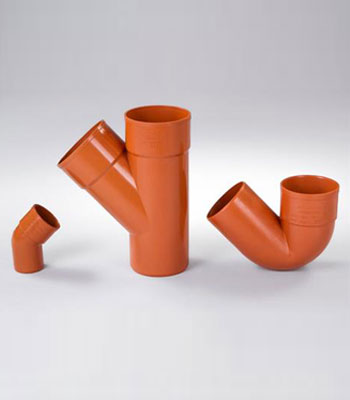
Hard UPVC Construction Sewage Fittings
0,00 €Introduction
Unplasticized polyvinyl chloride (UPVC) is one of the lightweight polymers that have high strength and impact resistance. Pipes and fittings made of this material exhibit excellent resistance in corrosive environments. Nano-scale fillers due to their high specific surface area give these polymers unique properties. Addition of nanoparticles to the UPVC polymer improves its mechanical and physical properties. This product is a nanocomposite 90 degree elbow, in which the addition of nanoparticles has improved the impact resistance, thermal stability and Vicat softening temperature.
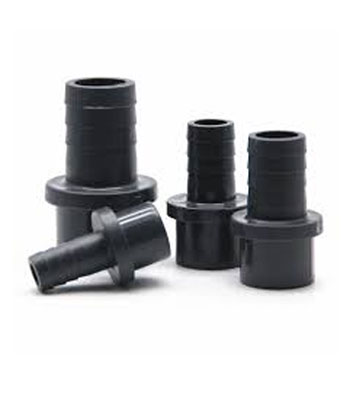
Hard UPVC Fittings
0,00 €Introduction
Hard polyvinyl chloride (UPVC) is used to produce a wide range of plastic pipes and fittings. This material is remarkably resistant to chemical erosion and has a smooth interior surface which improves water flow. UPVC has high chemical resistance across its working temperature range, with a wide range of operating pressures. Due to some features including long-term strength, high stiffness and affordability, UPVC systems are widely used in plastic fittings and pipes. It has been demonstrated that the addition of nanoparticles significantly improves the strength and stiffness of UPVC.
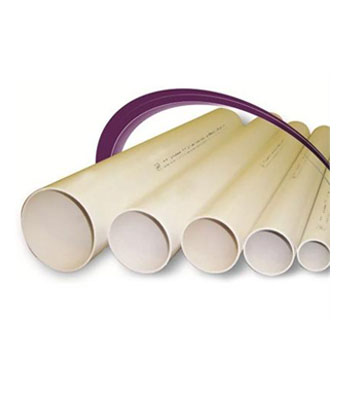
UPVC Water Supply Pipe
0,00 €Introduction
Water pipes are mainly used for water supply, sewage and drainage applications. These pipes are made of polyvinyl chloride (PVC) which widely used in buildings. Addition of lubricants makes this material softer and more flexible than plastics. If no lubricants or plasticizers are added to it, the resulting material is known as UPVC. The chemical resistance of this polymer has made it suitable for wide applications in different industries, especially the pipe industry. These pipes are supposed to have chemical and corrosion resistance, high elasticity modulus and flexibility, longterm tensile strength, high strength to weight ratio and wear resistance. However, it should be noted that these pipes can be fragile when exposed to cold weather. Besides, they can be deformed and lose their strength because of high temperature. Addition of appropriate nanoparticles can obviate these deficiencies and improve their properties.
UPVC Sewer Pipes
0,00 €Introduction
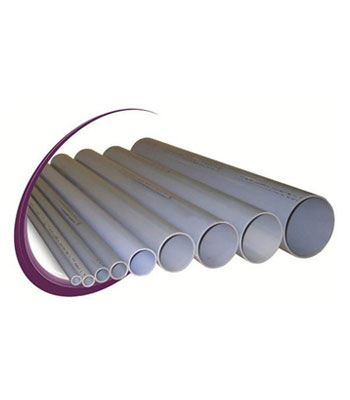
Nowadays, the most of sewage pipes are made of UPVC. Polyvinyl chloride (PVC) is one of the most widely used plastics in construction and buildings which has various applications. Addition of lubricants makes this material softer and more flexible than plastics. If no lubricants or plasticizers are added to it, the resulting material is known as UPVC. The chemical resistance of this polymer has made it suitable for wide applications in different industries, especially the pipe industry. These pipes are supposed to have chemical and corrosion resistance, high elasticity modulus and flexibility, long-term tensile strength, high strength to weight ratio and wear resistance. However, it should be noted that these pipes can be fragile when exposed to cold weather. Besides, they can be deformed and lose their strength because of high temperature. Addition of appropriate nanoparticles can obviate these deficiencies and improve their properties.
Hard UPVC Pipe
0,00 €Introduction
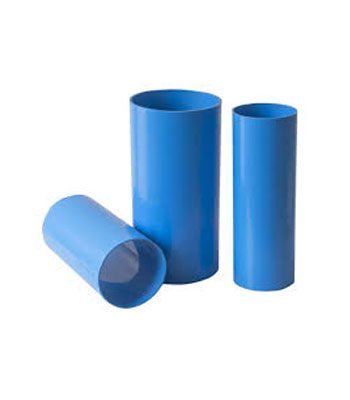
Polyvinyl chloride (PVC) is the third most common synthetic polymer after polyethylene (PE) and polypropylene (PP). PVC is a lightweight plastic that is used in the construction. Addition of lubricants makes this material softer and more flexible than plastics. If no lubricants or plasticizers are added to it, the resulting material is known as UPVC (unplasticized polyvinyl chloride). UPVC has high chemical resistance across its working temperature range, with a wide range of operating pressures. Due to some features including long-term strength, high stiffness and affordability, UPVC systems are widely used in plastic fittings and pipes. It has been demonstrated that the addition of nanoparticles significantly improves the strength and stiffness of UPVC.
Antibacterial Toilet
0,00 €Introduction
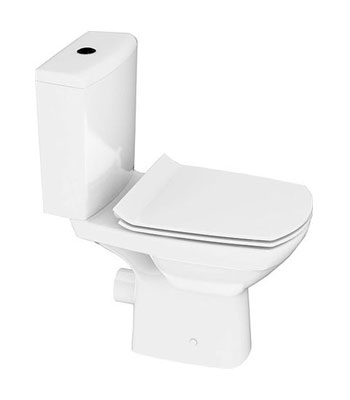
When using public restrooms, people are often worried about sanitary issues and their related illnesses. People are often sensitive to this issue, so they take special care when using and touching the equipment. Genital infections, fungal infections, skin sensitization and infectious, and microbial diseases are one of the most common causes of these bacteria. This product is an antibacterial squat toilet containing zinc oxide nanoparticles. The antibacterial toilet has surfaces which are resistant to bacterial growth. Sanitary products like wash basin are coated with materials which remove hazardous microorganisms, such as bacteria, viruses, fungi and other germs. In comparison with other metal oxides, the application of zinc oxide in biomedical and antiviral fields is due to its compatibility, solubility in alkaline environments, and terminated polar surfaces.
Golden Steel Sheet for Facades
0,00 €Introduction
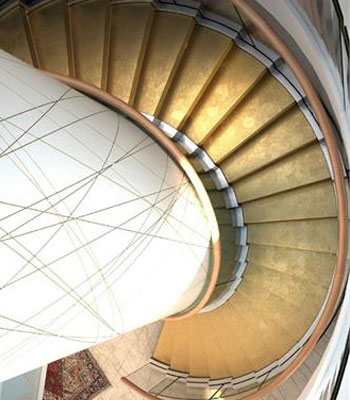
The design of the facade is of great importance in every building, because it is the first part of the building to be exposed, and it will be very effective in creating the initial mentality of someone who enters the building. The use of special designs and colors in interior and exterior decoration is welcomed by manufacturers and buyers. One of the more recent designs is the use of golden elements made of stainless steel with TiN golden coatings. These ceramic coatings, in addition to the strength and mechanical properties, provide good corrosion resistance. There are different methods to apply TiN coatings on substrates. Arc-PVD is a kind of physical vapor deposition technique in which an electric arc is used to vaporize material from a cathode target. The vaporized material then condenses on a substrate and forms a thin film.
Antibacterial ABS Granule
0,00 €Introduction
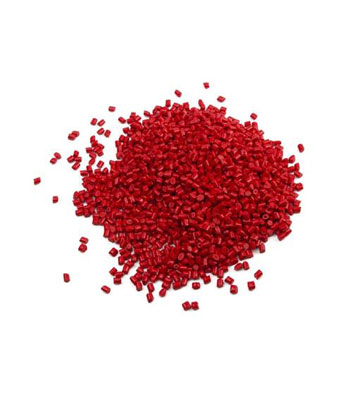
ABS polymer is composed of three different monomers, including Acrylonitrile, Butadiene and Styrene, in which each monomer gives unique properties to the final product. Some of these properties are transparency, flexibility, and polarity and chemical resistance which are created by styrene, butadiene, and acrylonitrile, respectively. Therefore, by changing the percentage of each monomer in composition, several grades of ABS can be produced. This material has different applications such as plastic parts that are used in home appliances. ABS masterbatch granules are produced using modified antibacterial nanomaterials. To gain better properties which facilitate the use of ABS in fabrication of components with antibacterial feature, this material can also be mixed with other polymers, such as polyvinyl chloride or polycarbonate.
Desulfurization Nanocatalyst
0,00 €Introduction
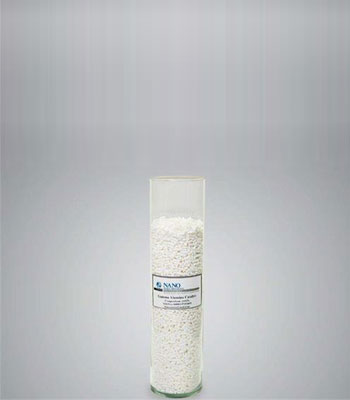
Oxides of sulfur and nitrogen are the main air pollutants that are also responsible for acid rain. Excessive sulfur content in petroleum fractions such as naphtha, in addition to causing air pollutants, can corrode tanks, reactors, pipes and fittings. Currently desulfurization is carried out using desulphurization catalysts adjacent to hydrogen; thus at a certain temperature and pressure, as well as a specific proportion of hydrogen, sulfur atoms convert to hydrogen sulfide. Catalysts based on γ–alumina are commonly used for desulphurization. Alumina has various applications including ceramic membranes, paints, refinery and chemical catalysts, pollution control and base catalyst. The mesoporous γ–alumina with pore diameter in the range of 2 to 50 nm due to its high specific surface area, high porosity, good thermal stability and suitable pore distribution is used as the most common base catalyst in desulphurization.
Desulfurization Catalyst containing Zinc Oxide Nanoparticles
0,00 €Introduction
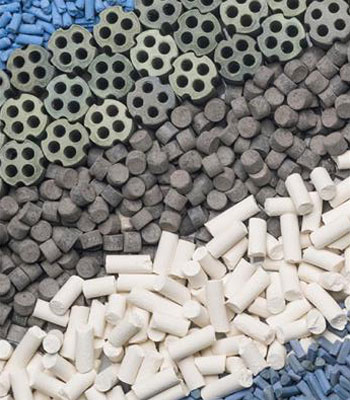
Sulfur compounds are one of the main pollutants of the air and chemical processes which damage human health, water resources, catalysts and other devices. Removing sulfur compounds is one of the main processes in fossil fuel applications. Various inorganic sorbents are used to remove H2S in such applications. Among sorbents, zinc oxide is one of the most important sorbents for removal of H2S at moderate temperatures. This advantage is due to the fact that the thermodynamics of the ZnO-H2S reaction is more favorable than other desulfurizing sorbents and also has a higher sulfur absorption capability. Nanotechnology, relying on its unique features, has improved the performance and properties of the products.
Gas Turbine Air Filter0
0,00 €Introduction
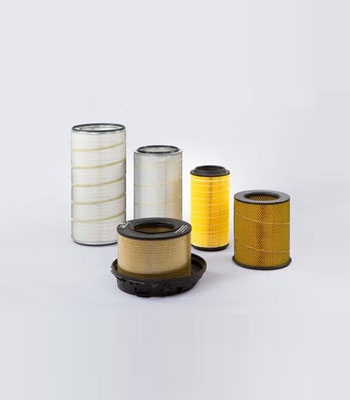
Proper air filtration is critical to the overall performance and reliability of gas turbines. The latest evolution in the filtration industry is the use of nanotechnology in this field. With this technique, the surface of large cellulosic or synthetic textiles (usually 10 to 30 micrometers in diameter) is covered with a layer of ultra-fine textiles (typically 50 to 400 nanometers in diameter). There are two different methods for separating particles in the filter paper structure.
In-depth filtration, in which particles are separated in different layers of paper according to their size; and surface filtration, in which all particles are separated on the surface of paper. In Behran Co. before pleating process, the filter paper is covered with a layer of Polyamide textiles with diameter of less than 100 nanometer by using electrospinning process.
